Several graphics cards on sale today come in two versions that differ only in memory: 8 GB or 16 GB, same chip, same name, a price gap in between. Whether the cheaper one is a sensible saving or a trap depends on what you play, at what resolution, and whether you will ever run a local AI model. This article answers it with the figures we have.
The cards this is about
From our catalogue, the current and recent 8 GB cards, with the performance index our bottleneck detector uses to rank them:
| Card | Index | Draw |
|---|---|---|
| GeForce RTX 5060 Ti 8GB | 5,300 | 180 W |
| GeForce RTX 4060 Ti 8GB | 5,000 | 160 W |
| GeForce RTX 5060 | 4,700 | 145 W |
| Radeon RX 9060 XT 8GB | 4,600 | 150 W |
| GeForce RTX 4060 | 4,300 | 115 W |
| Radeon RX 9060 | 4,000 | 130 W |
| Radeon RX 7600 | 3,900 | 165 W |
| GeForce RTX 5050 | 3,600 | 130 W |
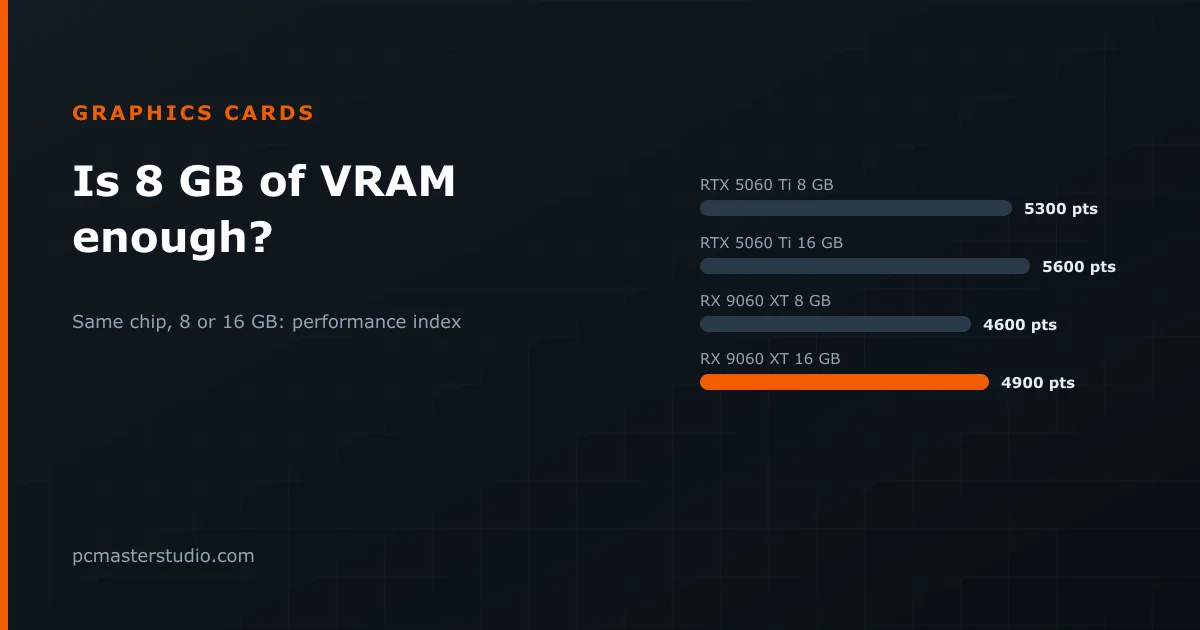
Three of them have a 16 GB twin, and the pairs are the cleanest way to see what the memory alone is worth:
| Chip | 8 GB | 16 GB | Difference |
|---|---|---|---|
| RTX 5060 Ti | 5,300 | 5,600 | +6 % |
| RX 9060 XT | 4,600 | 4,900 | +7 % |
| RTX 4060 Ti | 5,000 | 5,500 | +10 % |
Why an average hides the problem
Video memory does not make a card faster. It is a container. As long as everything a game needs for the current scene fits in it, 8 GB and 16 GB perform identically — which is why most benchmarks show the two versions level. The moment the scene needs more than fits, the card has to fetch textures and geometry over the PCIe bus from system memory, which is many times slower. The result is not a lower average frame rate but stutter: sudden hitches, textures that load late or stay blurry, and in the worst cases a game that refuses its higher settings.
That is why a single index gives the 16 GB versions only a 6–10 % edge while owners of the 8 GB ones report some games as unplayable at settings the 16 GB card handles smoothly. Both are true. The question is how many of the games you play are on the wrong side of the line.
What games ask for now
Our reading of the requirements of 25 games released since 2023 is in what recent PC games actually ask for. The relevant findings: 8 GB still clears the recommended tier of most of them, but it has become the number publishers write explicitly next to the card, and a few have moved past it — Indiana Jones and the Great Circle asks for 8 GB at minimum and 12 GB recommended, and DOOM: The Dark Ages recommends 10 GB. Recommended tiers are usually written for 1080p or 1440p at medium-to-high settings, not for maximum textures.
The settings that decide it
- Texture quality is by far the biggest consumer of video memory and costs almost nothing in frame rate while it fits. On an 8 GB card, stepping textures down one notch from the maximum is usually the whole fix.
- Resolution scales the size of every buffer. 1080p is where 8 GB is comfortable; 1440p is where it starts to pinch in new releases; at 4K it is the wrong card regardless.
- Ray tracing adds its own acceleration structures, often a gigabyte or more.
- Frame generation keeps extra frames in memory. The feature marketed to help lower-end cards is one that costs the resource those cards have least of.
And for local AI
For running language models, memory is not one factor among many: it is the gate. An 8 GB card runs 7–8 billion-parameter models at 4 bits with a short context — Llama 3.1 8B needs about 5.7 GB, Qwen3 8B about 5.9 GB — and not much more. At a 32K context most of those no longer fit, and the 12–14B class that is noticeably more capable needs 9–10 GB. A 16 GB card opens that whole class and gpt-oss-20b besides. The full table is in our article on how much VRAM local models need, and the VRAM calculator works it out for any combination.
So, is 8 GB enough?
Yes, for a 1080p machine playing esports titles and most current releases at sensible settings, bought at a price that reflects the smaller memory, or for a card you already own. Lowering textures one step is a small price.
No, if you are buying new, plan to keep the card for several years, want 1440p, or have any interest in local AI — and above all when the 16 GB version of the same chip is on sale for a modest premium. That premium is the cheapest insurance in PC building: requirements only move in one direction, and the memory cannot be upgraded later.
Where this can be off
Games manage memory very differently, and patches change it; a title that stutters at launch on 8 GB may be fine a few months later. Driver versions and the operating system's own use of video memory move the line too. And our index is an average weighted towards gaming performance, not a measurement of any one game — treat it as the ranking, and the game-specific requirements as the verdict. How the index is built is on the methodology page.