AMD's processors with "X3D" in the name have become the default answer to "what is the best gaming CPU", and the reason is not clock speed or core count. It is a slab of extra cache stacked on top of — or since the 9000 series, underneath — the cores. This article explains what that cache does, puts the X3D chips next to their plain siblings on one scale, and says plainly where the extra money buys nothing.
What the "3D" is
Every processor keeps a small, very fast memory next to its cores: the cache. When the data a core needs is already there, it gets it in a few nanoseconds. When it is not, the core waits for system RAM, which is many times slower. Games are unusually bad for this. Their working set — positions, physics state, AI, draw calls for thousands of objects — is large and jumps around every frame, so a normal-sized cache keeps missing.
AMD's answer, called 3D V-Cache, is to bond an extra 64 MB of cache die directly onto the processor's compute die, tripling the last-level cache of an eight-core chip to 96 MB. More of the game fits close to the cores, fewer frames stall on memory, and the gain shows up most in exactly the frames that matter: the slow ones.
The first generation paid for this with heat. The cache sat on top of the cores, insulating them, so the X3D parts ran at lower clocks and could not be overclocked. The Ryzen 9000 generation flipped the stack and put the cache underneath, which is why the 9800X3D clocks close to its non-X3D sibling and can be tuned.
The same scale, side by side
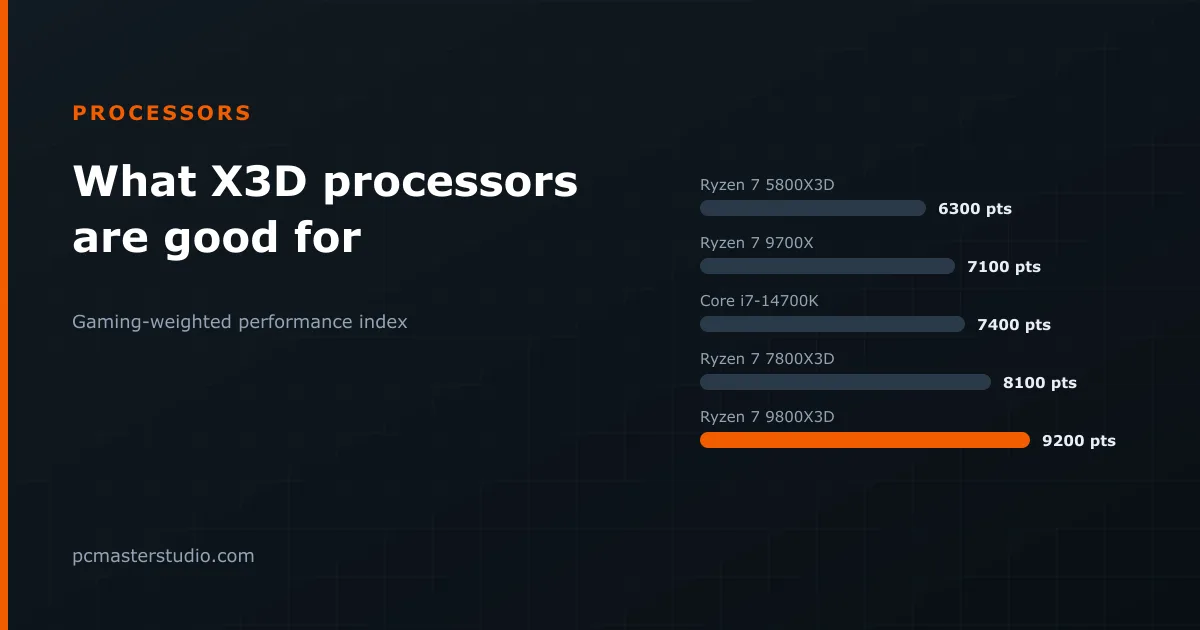
These are values from the performance index our bottleneck detector uses to place processors and graphics cards on one line. It is weighted towards gaming, which is the question here. Power is the rated figure.
| Processor | Cores / threads | Rated power | Index |
|---|---|---|---|
| Ryzen 9 9950X3D | 16 / 32 | 170 W | 9,400 |
| Ryzen 7 9800X3D | 8 / 16 | 120 W | 9,200 |
| Ryzen 9 9900X3D | 12 / 24 | 120 W | 8,800 |
| Ryzen 7 7800X3D | 8 / 16 | 120 W | 8,100 |
| Core Ultra 7 265K | 20 / 20 | 250 W | 7,700 |
| Core i7-14700K | 20 / 28 | 253 W | 7,400 |
| Ryzen 7 9700X | 8 / 16 | 65 W | 7,100 |
| Ryzen 7 7700X | 8 / 16 | 105 W | 7,000 |
| Ryzen 7 5800X3D | 8 / 16 | 105 W | 6,300 |
| Ryzen 7 5700X3D | 8 / 16 | 105 W | 6,100 |
What the table says
Cache beats cores, for games
The cleanest comparison is the 9800X3D against the 9700X: same architecture, same eight cores, and the only meaningful difference is the stacked cache. The index rises from 7,100 to 9,200, about 30 %. In the previous generation the 7800X3D sits about 16 % above the 7700X on the same basis. That gap is the whole value of the technology, measured with nothing else changing.
The comparison with Intel's twenty-core chips makes the same point from the other side. The 14700K has two and a half times the cores and draws about twice the power, and in games it lands roughly a quarter below the 9800X3D. Games do not use twenty cores. They do use cache.
More cores do not help, and can get in the way
The twelve- and sixteen-core X3D chips carry the stacked cache on only one of their two core clusters in most models. For games, the operating system has to steer the game onto the cluster with the cache and park the other, and when that scheduling goes wrong the extra cores cost performance rather than adding it. The 9900X3D scoring below the eight-core 9800X3D is that effect in one line of the table. These chips exist for people who game and render, compile or encode on the same machine; for gaming alone, the eight-core part is the one to buy.
The older X3D chips are the value story
The 5800X3D and 5700X3D run on the AM4 platform with DDR4 memory. They trail the new generation, but someone who already owns an AM4 board can drop one in and land close to a brand-new 7700X without replacing the motherboard or the RAM. That is often the best upgrade per euro in a gaming machine, and it only exists because of the cache.
Where the extra money buys nothing
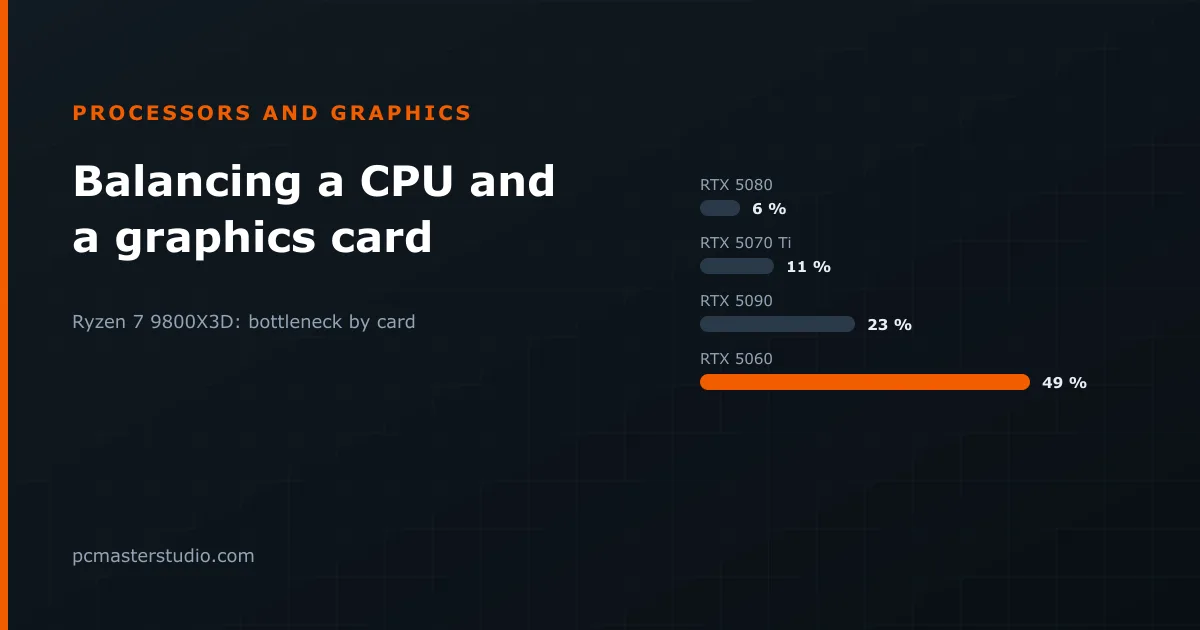
At high resolution. At 4K almost every game is limited by the graphics card. The processor spends much of each frame waiting for it, so a faster one changes little. The X3D advantage is large at 1080p with a high-refresh monitor and shrinks steadily as the resolution rises. The bottleneck detector will tell you which side of that line your pairing is on.
For productivity work. Rendering, video encoding and code compilation scale with cores and clock speed, and mostly do not care about the extra cache. There, a sixteen-core non-X3D chip or Intel's high-core-count parts give more for the money. Our compilation benchmark shows the pattern for build times specifically.
With a mid-range graphics card. A 9800X3D paired with an entry-level card is a processor that will spend most of its time waiting. The balanced build usually beats the lopsided one.
Where these figures can be off
A single index cannot capture how differently games respond to cache. Simulation and strategy titles, competitive shooters at very high frame rates and large open worlds gain the most; games that are mostly limited by the graphics card gain little. Memory speed, the operating system's scheduler and BIOS updates all move the numbers too. Treat the table as a ranking and read reviews for the specific games you play before paying the premium. The index and its limits are described on the methodology page.