
Air cooling vs Liquid (AIO)
A cooler has one job: move the processor's heat into the room without making a racket. Both kinds do it well at the same price. What actually separates them is what fits in your case, what is above your memory, and how you feel about a pump.
We may earn a commission if you make a purchase through our links, at no extra cost to you. This helps support our work.
Side by side
| Specification | Air cooling | Liquid (AIO) |
|---|---|---|
| Typical capacity | 150–280 W for a good dual-tower | 240–400 W depending on radiator length |
| What limits the fit | Height, and clearance over the memory slots | Whether the case takes that radiator length |
| Moving parts | Fans only | Fans and a pump |
| Expected life | A decade or more; fans are replaceable | Typically five to seven years, then the pump is the limit |
| Noise at idle | Silent — the fans can stop entirely | A pump hum is always present, however faint |
| Effect on the case | Dumps heat inside, so the case fans matter more | Moves heat straight out through the radiator |
| Failure mode | A fan gets noisy; temperatures creep up slowly | The pump stops and the processor overheats immediately |
| Small cases | Low-profile coolers exist down to 37 mm | Often the only way to cool a hot chip in an ITX build |
Which to pick
- You want the machine to be quiet at idle. A good tower with the fans stopped makes no noise at all, and a pump cannot match that.
- You want it to still be working in ten years. There is nothing in an air cooler to wear out but the fan, and fans are a few euros.
- Your processor is 150 W or below, where a dual-tower has capacity to spare and a radiator solves a problem you do not have.
Which to pick
- The processor is a 200 W-plus part under sustained load, where a 360 or 420 mm radiator has headroom no tower matches.
- The case has no room above the socket but plenty on the top or front panel — a common shape in modern chassis.
- You want tall memory, an unobstructed view of the board, or a display on the pump block. These are aesthetic reasons and they are perfectly valid ones.
Frequently asked questions
Is liquid cooling always better?
No. At the same price a good dual-tower matches a 240 mm AIO and beats a 120 mm one, while being quieter at idle and lasting longer. Liquid pulls ahead at 360 mm and above, and in cases where a tall cooler simply does not fit.
Can an AIO leak?
It is rare in a sealed unit from a reputable maker, and most carry a warranty that covers the parts it would damage. The far more common end is the pump simply wearing out, which is why an AIO has a service life where an air cooler does not.
Where should the radiator go?
At the top, exhausting upwards, is the usual answer: it keeps the pump below the highest point of the loop, which stops air collecting in it. Front-mounted works and cools the processor slightly better, at the cost of warming the air the graphics card gets.
Will a big cooler block my memory?
It can, and it is worth checking before buying. Dual-tower coolers usually clear standard-height sticks and collide with tall RGB ones; the fix is either low-profile memory or sliding the cooler's front fan upwards, which costs a little performance.
How do I know my cooler is enough?
Compare its rated capacity in watts against the processor's TDP, and leave some margin — a cooler rated at exactly the chip's TDP will hold it in the high eighties. The assembly simulator on this site does the comparison for you and warns when it is tight.
Related reading
Articles that explain the numbers this page works with, with worked examples and sources.
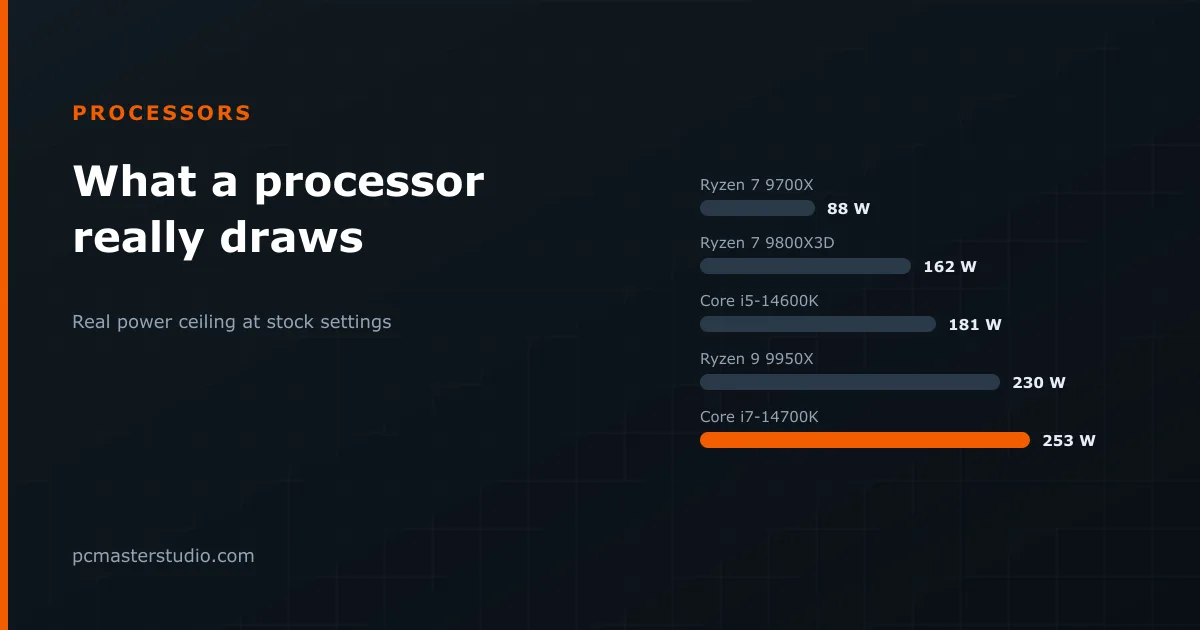 TDP, PPT, PL1 and PL2: what a processor really draws, and the cooler it needsAMD and Intel print different figures under similar names. The real power ceiling of fourteen processors, why games rarely reach it, and how to size the cooler.
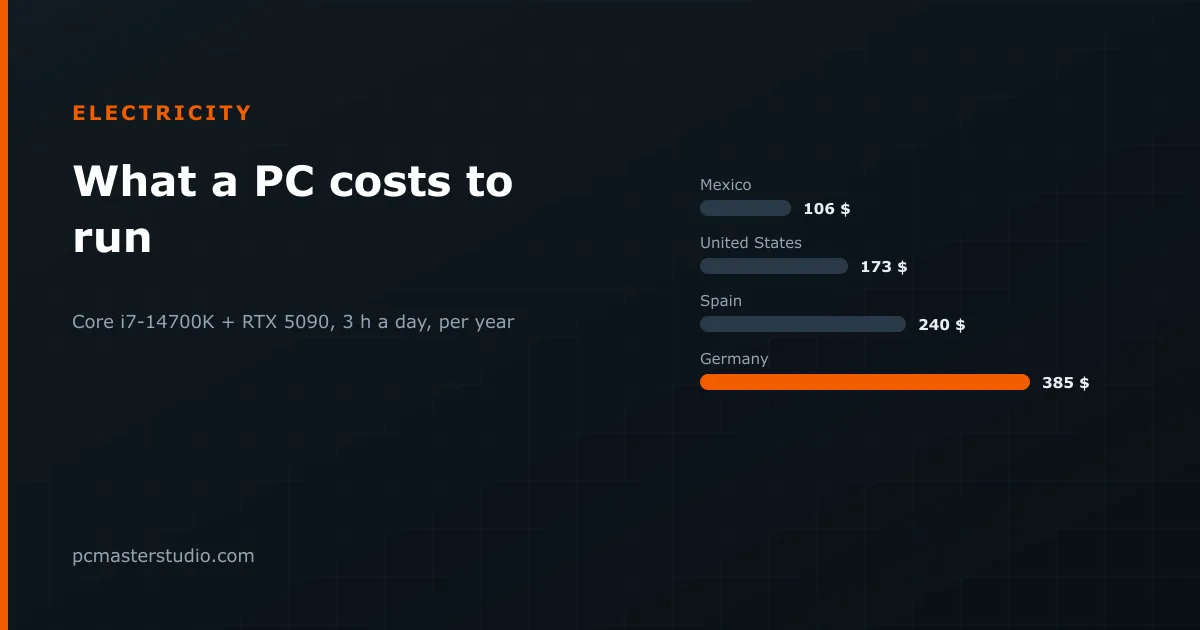 What a PC Actually Costs to RunYour power supply's wattage is not your consumption. What three typical builds really cost a year in four countries, why hours matter most, and the savings that are worth making.
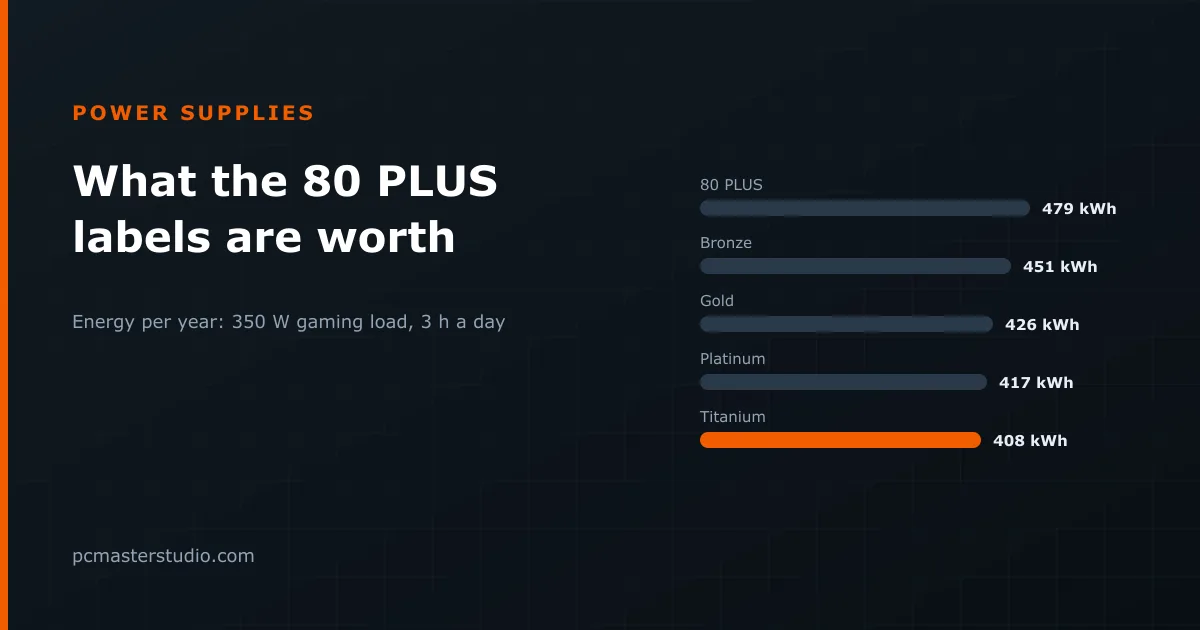 80 PLUS Gold or Platinum? What the power supply labels are worthThe efficiency metals save a few euros a year between neighbouring tiers. What 80 PLUS does not certify, and why ATX 3.1 matters more with a modern graphics card.
Keep going
Other tools and reference pages that pick up where this one leaves off.