The most widespread confusion about what a PC costs to run is reading the power supply's wattage as the machine's consumption. It is not. An 850 W unit states what it can deliver, not what the system asks for. A PC with that supply spends most of its life drawing a fraction of the figure — and the bill is set by that fraction, the hours, and the price of a kilowatt-hour where you live. This article puts numbers on all three.
The formula
Our electricity cost calculator uses the only formula there is:
cost = watts ÷ 1000 × hours × price per kWh
Every figure below comes from it. What changes the answer is what you feed in, and the three inputs are worth taking one at a time.
1. The draw: what the machine actually uses
A desktop's draw depends on what it is doing. While gaming, the graphics card and processor are both working and the machine approaches its full load. While browsing, writing or watching video, the same machine draws a small part of that, because modern processors and graphics cards drop their clocks and voltages aggressively when idle.
For planning, the useful figure is the full-load draw, because it is the ceiling your gaming hours will approach. Our power supply calculator adds the graphics card, the processor and 50 W for the board, memory, drives and fans. For three typical machines:
| Build | Full-load draw | Energy per year, 3 h a day |
|---|---|---|
| Ryzen 5 7600 + RTX 5060 | 260 W | 285 kWh |
| Ryzen 7 9800X3D + RTX 5070 Ti | 470 W | 515 kWh |
| Core i7-14700K + RTX 5090 | 878 W | 961 kWh |
2. The price: the variable with the widest spread
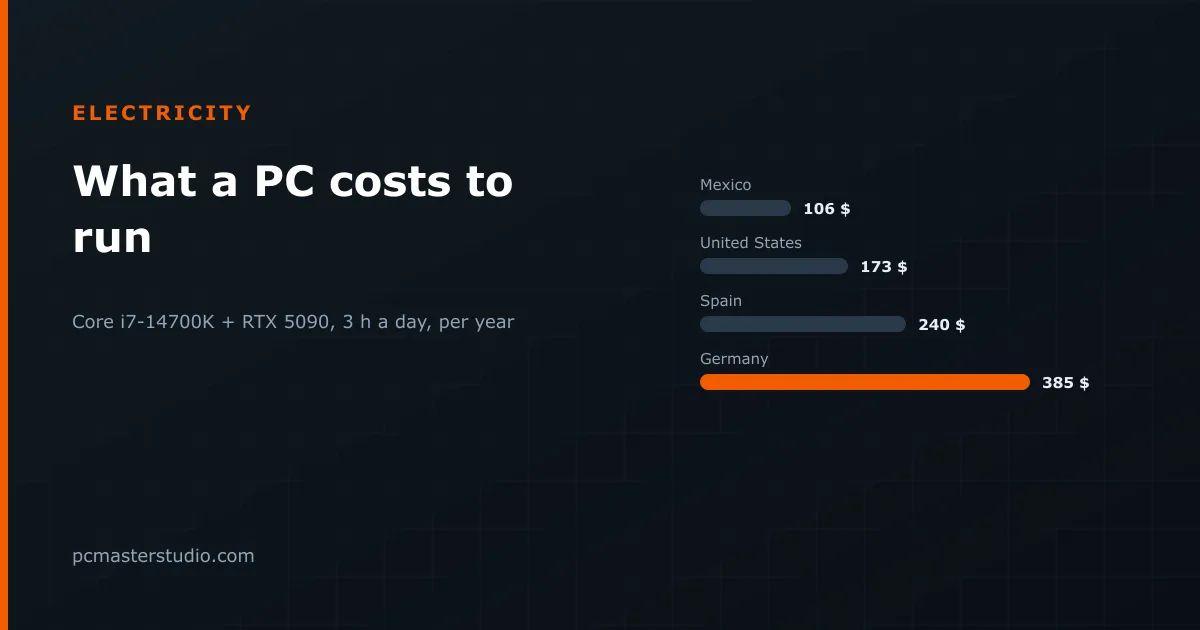
The same machine costs very different amounts depending on where it is plugged in. Using the rates in our calculator, converted to US dollars per kWh:
| Build, 3 h of gaming a day | Mexico ($0.11) | United States ($0.18) | Spain ($0.25) | Germany ($0.40) |
|---|---|---|---|---|
| Ryzen 5 7600 + RTX 5060 | $31 / year | $51 / year | $71 / year | $114 / year |
| Ryzen 7 9800X3D + RTX 5070 Ti | $57 / year | $93 / year | $129 / year | $206 / year |
| Core i7-14700K + RTX 5090 | $106 / year | $173 / year | $240 / year | $385 / year |
The spread is almost four to one between the cheapest and dearest country on the list. That is why generic advice such as "a gaming PC costs about $100 a year" is worthless: it is true somewhere and wrong nearly everywhere else.
3. The hours: linear and unforgiving
Hours multiply everything else. The high-end machine above, at Spanish prices:
| Hours at full load per day | Cost per year |
|---|---|
| 1 hour | $80 |
| 3 hours | $240 |
| 6 hours | $481 |
| 10 hours | $801 |
At ten hours a day — a rendering box, a home server running a language model, a machine left mining or folding — the running cost of a flagship build approaches the price of a mid-range graphics card every year. That is the point at which power efficiency stops being a detail.
Where efficiency genuinely pays
On a moderately used gaming machine, the choices people agonise over save very little. Moving from an 80 PLUS Gold power supply to Platinum improves efficiency by about two points at half load, which on the mid-range machine above is a couple of dollars a year at three hours a day. The large levers are elsewhere:
- The graphics card you buy. Between the RTX 5060 and the RTX 5090 on the table, the card alone accounts for 430 W of the difference. Buying the card your resolution needs, rather than the biggest one, is the single largest saving.
- A frame-rate cap. A card that renders 300 frames a second for a 144 Hz monitor is burning power on frames nobody sees. Capping the frame rate near the monitor's refresh rate cuts the draw substantially in lighter games.
- Power limits. Most processors and graphics cards run far up their efficiency curve at stock. Lowering the power limit — AMD's Eco Mode, or the power limit slider in the graphics driver — costs a few percent of performance and saves a large share of the draw.
- Sleep instead of idle. A machine left on overnight at idle draws little per hour, but over eight hours every night it adds up. Sleep uses a few watts at most.
The cost people forget: heat
Every watt the machine draws ends up as heat in the room. An 878 W gaming session is, thermally, a small space heater. In winter that is partly useful. In summer you pay for it twice: once to run the PC, and again to run the air conditioning that removes its heat. A typical air conditioner moves about three units of heat for each unit of electricity, so in a cooled room the true cost of a gaming session is roughly a third higher than the table shows.
Where these figures can be off
The draws are rated upper bounds, not measurements; real games load the processor and the card unevenly, and the true average is lower. The machine also draws something while idle, which a three-hours-of-gaming figure leaves out. And tariffs change, sometimes monthly. For your own number, put your components into the power supply calculator to get the draw, then that draw, your hours and the price on your bill into the electricity cost calculator. The formulas behind both are on the methodology page.