Every game frame is built in two stages. The processor works out what happens — physics, AI, what needs drawing — and hands the result to the graphics card, which draws it. Whichever is slower sets the frame rate, and the other waits. A "bottleneck" is simply the name for the one doing the limiting, and there always is one. The useful question is not whether a pairing has one, but how big the gap is and whether it is costing you money. This article answers that for eleven real pairings.
How we measure the gap
Our bottleneck detector places every processor and graphics card on one performance index, weighted towards gaming, and compares them:
difference = (card index − processor index) ÷ the larger of the two
Within ±5 % the pair is balanced. Beyond that, the part with the lower index is the limit, and the size of the gap sets the label: up to 15 % minor, up to 35 % moderate, above that severe. The formula and its limits are on the methodology page.
Eleven pairings
| Processor | Index | Graphics card | Index | Verdict |
|---|---|---|---|---|
| Ryzen 5 5600 | 4,900 | RTX 5060 | 4,700 | Balanced (4 %) |
| Core i5-14600K | 6,900 | RTX 5070 | 7,100 | Balanced (3 %) |
| Core Ultra 7 265K | 7,700 | RX 9070 XT | 8,000 | Balanced (4 %) |
| Ryzen 5 7600 | 5,900 | RTX 5060 Ti 16GB | 5,600 | Card limit, minor (5 %) |
| Core i5-12400F | 4,600 | RTX 4060 | 4,300 | Card limit, minor (7 %) |
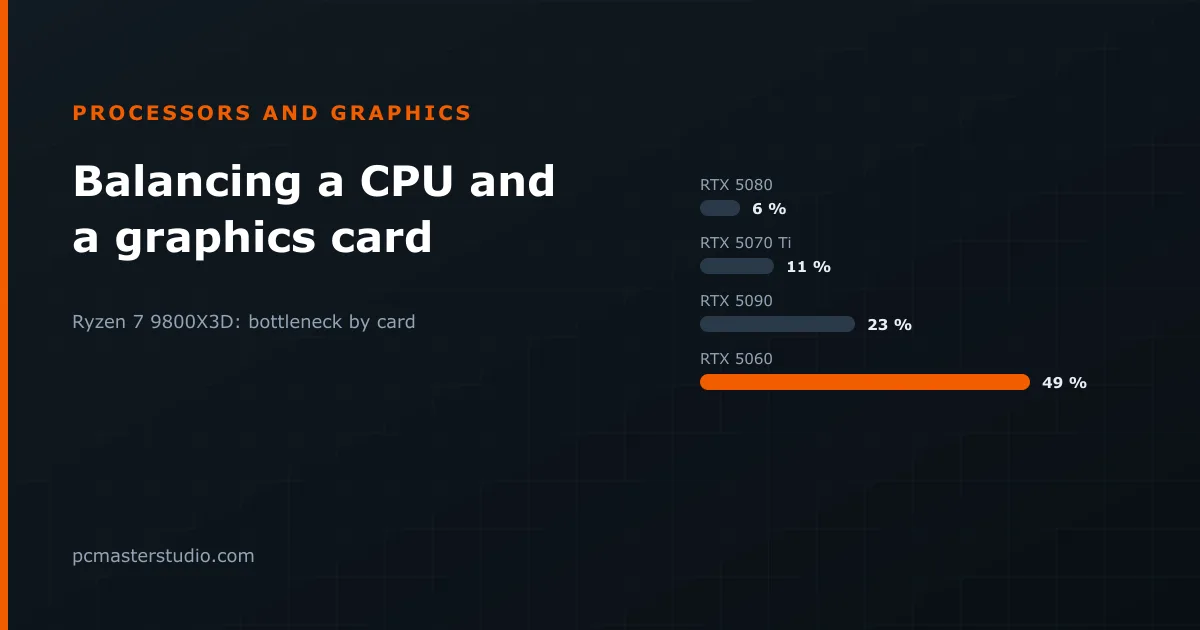
| Ryzen 7 9800X3D | 9,200 | RTX 5080 | 9,800 | Processor limit, minor (6 %) |
| Ryzen 7 9800X3D | 9,200 | RTX 5070 Ti | 8,200 | Card limit, minor (11 %) |
| Ryzen 7 9800X3D | 9,200 | RTX 5090 | 12,000 | Processor limit, moderate (23 %) |
| Ryzen 5 7600 | 5,900 | RTX 5070 Ti | 8,200 | Processor limit, moderate (28 %) |
| Core i5-12400F | 4,600 | RTX 5070 | 7,100 | Processor limit, moderate (35 %) |
| Ryzen 7 9800X3D | 9,200 | RTX 5060 | 4,700 | Card limit, severe (49 %) |
What the table teaches
Balanced pairs are cheaper than you think
The three balanced rows span the whole market, from a Ryzen 5 5600 with an RTX 5060 to a Core Ultra 7 with an RX 9070 XT. Balance is not about spending a lot. It is about spending in proportion, so that neither part is paid for and then left idle.
Even the fastest processor limits the fastest card
The RTX 5090 is so far ahead that no processor on the market keeps up with it on this scale: paired with the 9800X3D, one of the fastest gaming chips we list, the processor is the limit by 23 %. Even the 9950X3D2, the highest-scoring processor in our catalogue at 9,600, would leave a 20 % gap. That is not a reason to avoid the pairing. At 4K, where most people buying a 5090 play, the card has far more work per frame and the gap largely closes. It is a reason not to buy a 5090 for 1080p.
A severe gap is almost always a budget mistake
The last row — the 9800X3D with an RTX 5060 — is the classic mistake in reverse. The processor is nearly twice as fast as the card can use. The money spent on it would have bought a far better card, and the machine would have been faster in every game. A severe verdict nearly always means the budget was split wrongly, not that a part is bad.
Moderate is a judgement call
The Core i5-12400F with an RTX 5070 shows a 35 % processor limit. For someone upgrading only the graphics card on an existing machine, that can still be a sensible step — the card will be held back at 1080p but will stretch its legs at 1440p, and the processor can be replaced later. For a new build, it is money in the wrong place.
Resolution moves the answer
The index compares the two parts on one scale, but which one limits a real game depends heavily on resolution. The processor's work per frame barely changes between 1080p and 4K; the graphics card's work roughly quadruples. So:
- At 1080p with a high-refresh monitor, the processor limits more often than the table suggests. Competitive players at 240 Hz and above should lean towards a stronger processor.
- At 1440p, the table is a fair guide.
- At 4K, the graphics card is almost always the limit, and a processor-limit verdict matters much less.
Which side to overspend on
If the budget forces an imbalance, lean it towards the graphics card for a gaming machine. The card decides resolution, detail and ray tracing; the processor decides the frame rate ceiling. It is also easier to upgrade later — a new card drops into the same slot, while a new processor often means a new motherboard and memory. The exception is simulation, strategy and competitive titles at very high frame rates, which lean on the processor, and where a chip with a large cache such as the X3D models earns its premium.
Where this can be off
An index is an average across many games, and games differ enormously in how much they ask of each part. Settings matter too: ray tracing loads the card, crowded simulations load the processor. Use the verdict as a check on the budget split, then read reviews of the specific games you play. To test your own pairing, put both parts into the bottleneck detector; to check the pair can be powered, the power supply calculator takes the same two parts.