
AMD AM5 vs Intel LGA1851
The two current desktop sockets. This is a platform decision more than a processor one: it fixes your motherboard, your memory, your cooler mount and how long you can upgrade without starting again.
We may earn a commission if you make a purchase through our links, at no extra cost to you. This helps support our work.
Side by side
| Specification | AMD AM5 | Intel LGA1851 |
|---|---|---|
| Processors | Ryzen 7000, 8000 and 9000 | Core Ultra 200S and the 200S Plus refresh |
| Memory | DDR5 only | DDR5 only |
| Chipsets | X870E, X870, B850, B650, A620 | Z890, B860, H810 |
| Best for gaming | The X3D parts lead clearly, thanks to the stacked cache | Competitive but behind X3D in most titles |
| Best for multi-core work | Strong, and efficient with it | Very strong core counts at the top of the range |
| Idle and light-load power | Higher at idle because of the chiplet design | Notably lower at idle and in light use |
| Cooler compatibility | Keeps the AM4 mounting pattern — most older coolers fit | Needs an LGA1851 bracket, usually supplied or free from the maker |
| Upgrade path | AMD has committed to AM5 through 2027 at least | Nova Lake is expected to move to a new socket |
Which to pick
- Gaming is the priority. A Ryzen 7 9800X3D or 9850X3D is the fastest thing you can put under a graphics card, and nothing on the Intel side answers it.
- You want the board to outlive the processor. AM5 has years of support left, so the next upgrade can be a chip alone.
- You are reusing a good air cooler from an AM4 build — the mounting did not change.
Which to pick
- The machine idles far more than it works. Arrow Lake is markedly more frugal when it is not under load, which shows up on a bill and in fan noise.
- You want many cores for productivity and care less about the last few percent in games.
- You need the most modern I/O on the board itself — Thunderbolt 4 and a Gen5 M.2 are more consistently present on Z890.
Frequently asked questions
Will my AM4 cooler fit an AM5 processor?
Almost certainly. AMD deliberately kept the same mounting holes and the same keep-out area, so the large majority of AM4 coolers bolt straight onto AM5. Check the maker's compatibility list if it is an unusual model.
Is LGA1851 a dead end?
For upgrades, largely yes — Intel's next desktop generation is expected on a new socket, so a board bought today will most likely see one processor family. That matters if you upgrade often and not at all if you replace the whole machine every five years.
Which one runs cooler and quieter?
It depends on the load. Under sustained all-core work the top parts from both brands are hot and need serious cooling. At idle and in light use Intel is clearly the quieter of the two, which is what you hear most of the time.
Do I need the most expensive chipset?
Rarely. B850 and B860 carry everything a single-graphics-card gaming machine uses. The flagship chipsets buy extra PCIe lanes and M.2 slots, which matter if you are running several fast drives or a capture card, and are otherwise unused.
Which is better value overall?
Count the whole platform, not the chip. Add the processor, a board with the features you need and a DDR5 kit, then judge. AMD usually wins on gaming performance per euro and on how long the board stays useful; Intel is often more competitive once you include the board.
Related reading
Articles that explain the numbers this page works with, with worked examples and sources.
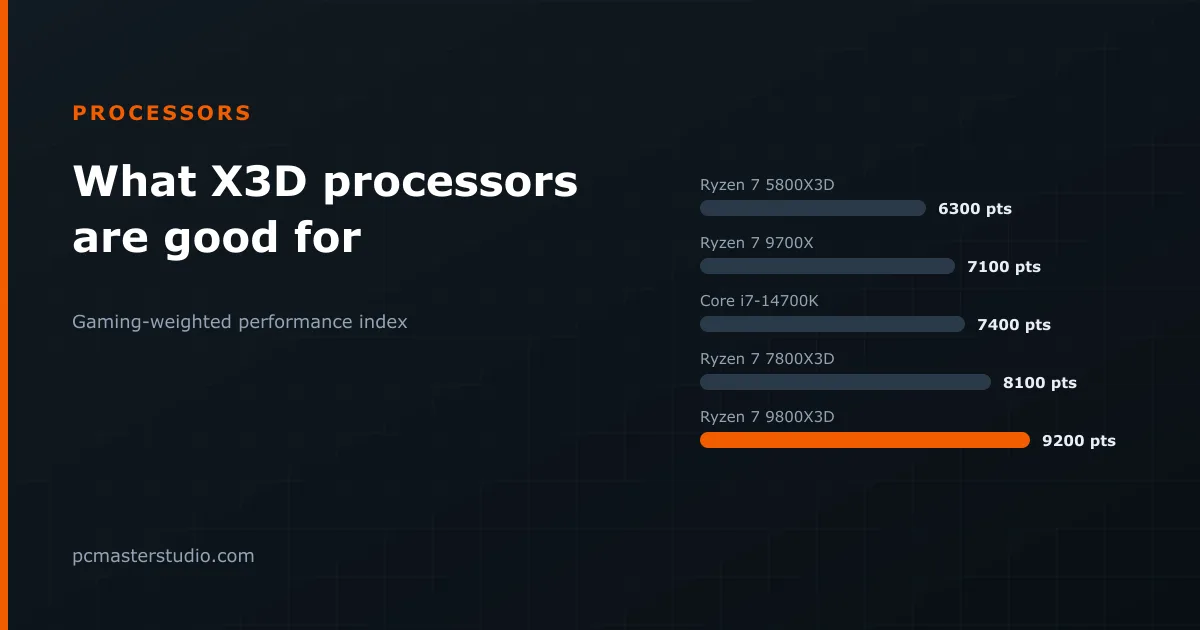 What AMD's X3D processors are good for, and when they are notStacked cache makes the 9800X3D about 30 % faster in games than the same eight cores without it. Ten processors on one scale, and the three cases where the premium buys nothing.
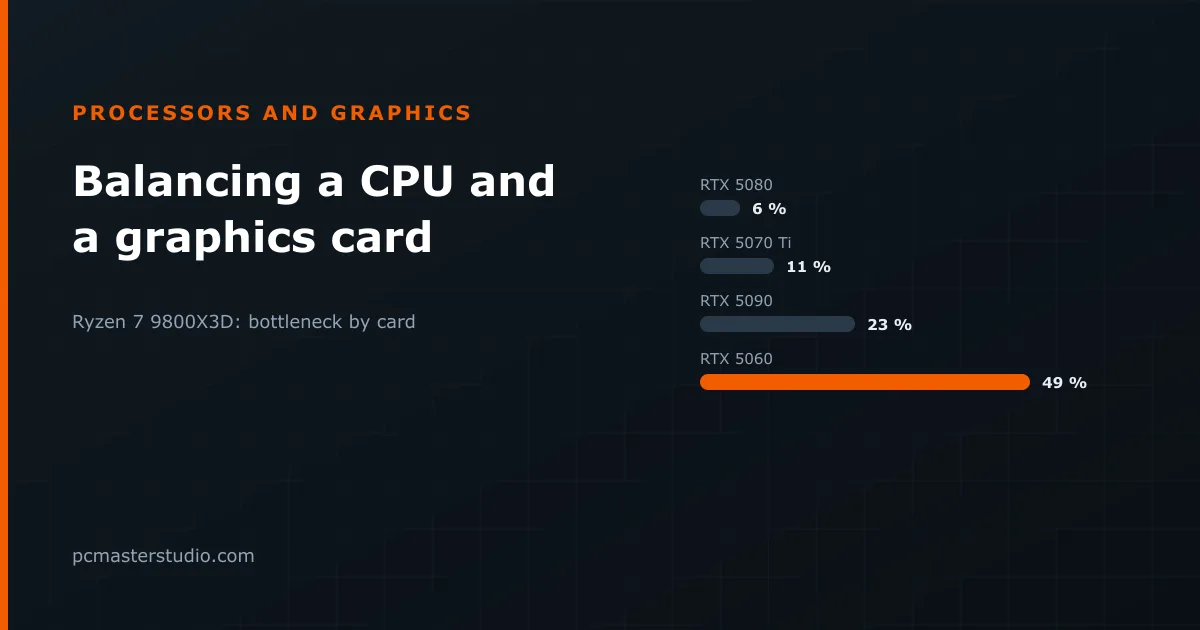 How to balance a processor and a graphics cardEvery pairing has a bottleneck; what matters is its size. Eleven real CPU and GPU pairings measured on one index, why resolution changes the answer, and where to overspend.
 DDR4 vs DDR5 in 2026: the performance-per-dollar verdictThe technical comparison between the two memory generations has not changed. The price has, enormously, and that inverts a good deal of the usual advice.
Keep going
Other tools and reference pages that pick up where this one leaves off.